

“You don’t need to be addicted to something for it to be wrong.” - Me talking to my friend, fellow peaceful parent, FoE Bro, and savage human Anthony Migliorino
This piece was inspired by a discussion I had with Anthony about how I dropped alcohol, not because I was addicted, but because I have evolved beyond it as a man.
We explained our POV on the subject in the Fraternity of Excellence, a community where you can hold intelligent debates without base emotions derailing productivity, as you see on most social media platforms.
I listened, he listened, we spoke, and went on our way, having shared our logic and evidence with one another to both educate and ensure neither of us had a blind spot; that’s what friends do, they challenge ideas with intelligent arguments.
And sometimes, those discussions plant seeds that sprout later. Today, that seed has sprouted; I wrote this piece to share the experience I have had with removing both alcohol and corporal punishment from my life for the same reason.
I’m sober from corporal punishment.
And it’s:
Not because I lost control.
Not because it destroyed my life.
Not because I was addicted to it.
I stopped because I finally admitted it was wrong.
I don’t hit my kids in moderation; I don’t justify it because I “turned out fine.” I don’t defend it with tradition, stress, or intent. Once I stripped the behavior away and looked at it honestly, I couldn’t rationalize it anymore…
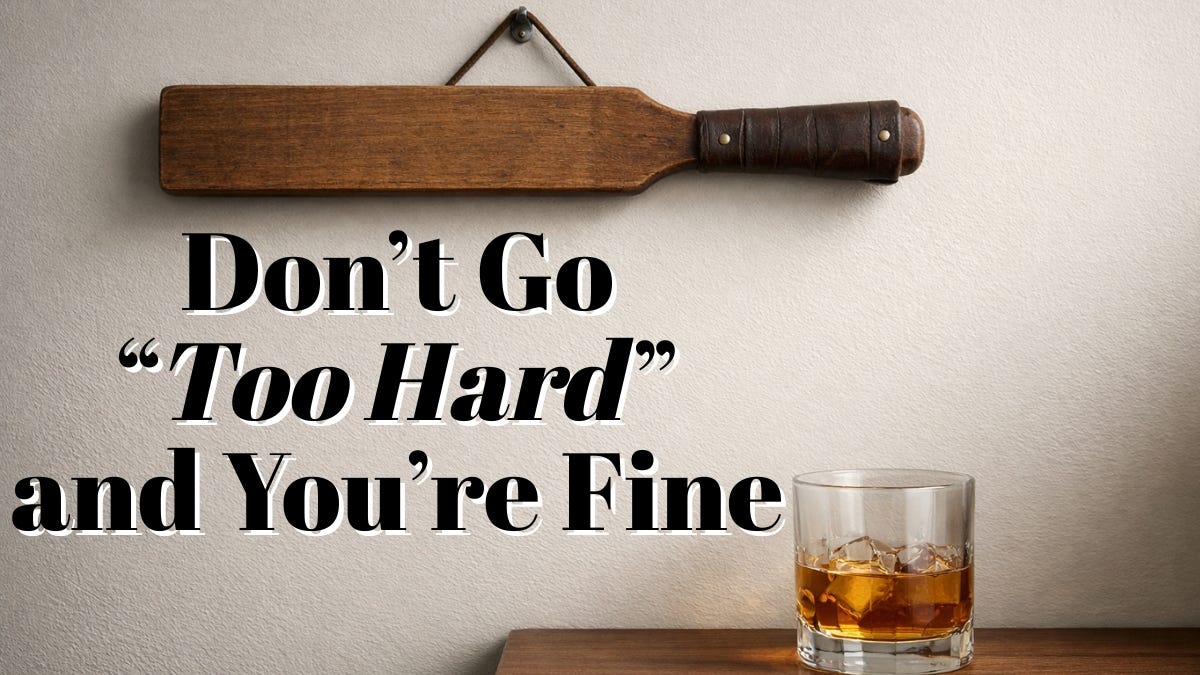
That’s how I see alcohol now.
I wasn’t a daily drinker, wasn’t hiding bottles, and I wasn’t missing work or detonating my relationships every weekend…
I’d gone sober from 2020 to 2024, and returned to booze in 2024-2025 without that demon in my head. During that time, I was, by modern standards, “drinking responsibly”, and yet, I was feeling “less than…”
I was more tired, less creative, not as consistent in the gym, and I realized that the times when alcohol was gone, the mental fog lifted, and in that clarity came a question I couldn’t outrun, “Why was I ever defending this in the first place?”
So, Jan 1, I quit again, and this time for good because it isn’t so I can “Get better and face my demons”. I am now sober because alcohol is terrible for you, period.
Corporal punishment and alcohol survive for the same reason.
Both are protected by the same phrase: It’s fine as long as you don’t “cross that line”.
That sentence does more damage than most people realize, as it reframes harm as a matter of dosage and turns ethical violations into tolerable degrees of offense.
It shifts the question from whether something is good to how much of it we can excuse. We already know this logic collapses elsewhere; no one says they only hit their boss when they’re really stressed, and no one claims it’s acceptable because it’s only the occasional swat across their wife's face.
No one argues that fear is healthy if it’s applied carefully, or that the argument, “Some people are allowed to hurt you to acceptable levels,” is okay, as we understand that harm doesn’t require addiction or excess to still be harm, and yet, after countless examples of destroyed lives, alcohol and spanking get a moral exemption.
Globally, alcohol contributes to roughly three million deaths every year, accounting for more than five percent of all deaths worldwide.
That isn’t just “alcoholics” who are suffering; that’s alcohol impacting everyone, and there’s no point in discussing “moderation”, as there are no safe levels of alcohol consumption when it comes to the discussion of cancer risks.
Even small amounts increase the likelihood of breast cancer, esophageal cancer, liver disease, and cardiovascular strain…
This isn’t ideology, it’s biology.
Still, culturally, alcohol is treated like a personality trait, a reward system, a social glue, a coping mechanism, and a rite of passage.

Moderation is not a moral argument; it’s a negotiating tactic.
Hitting a child often works in the short term, as does alcohol.
Both deliver immediate relief; one enforces obedience, the other numbs discomfort, and neither teaches regulation.
Corporal punishment teaches children that strong emotions are handled with force, while alcohol teaches adults that strong emotions are handled with chemicals.
Different tools, same lessons, all perpetuate trauma, and age badly.
The real damage of both behaviors doesn’t become obvious while you’re doing them; it shows up after, sometimes years later.
After you stop drinking, you’ll realize how much emotional processing you outsourced, how often you muted discomfort instead of learning from it, and how many conversations were dulled, delayed, or avoided.
After you stop hitting, you’ll recognize how often fear replaced trust, how often compliance replaced understanding, and how much it was your lack of patience and stress management that was the problem, not what the kids were doing.
Alcohol and corporal punishment aren’t dangerous because people abuse them; they’re dangerous because we excuse their destructive nature.
The regret that follows sobriety from Booze/Spanking isn’t dramatic or theatrical.
The regret you feel when your mind clears out is both sobering and uncomfortable.
It’s the realization that normalization is not the same as harmlessness, and the quiet admission that you defended something that didn’t deserve defending. You didn’t do it because you were malicious; you did it because you were conditioned.
These destructive habits are socially protected, and because questioning it meant questioning yourself, you (and everyone) merely looked the other way…
“I turned out fine” isn’t a conclusion; it’s a refusal to investigate the cost.
If you wouldn’t teach your child to cope this way, why are you modeling it?

This isn’t about superiority.
I’m writing from someone who was inside the problem and got out.
I defended alcohol the same way people defend corporal punishment, because it was normalized, excused, and easier to not look at too closely. Sobriety cleared my mind, and that’s important to recognize, as clarity has a way of stripping away excuses you didn’t realize you were protecting.
I didn’t quit alcohol because it destroyed my life, I quit because once I removed it, the justifications collapsed. The social scripts started to sound more hollow, the defenses felt borrowed, and the reasons I used to give suddenly sounded like excuses I’d inherited rather than conclusions I’d reached.
Sobriety didn’t make me better than anyone, but it put me in a position to stop slowing myself down, like dropping a heavy weight vest mid-race.
And that’s the uncomfortable truth people avoid when they reduce this conversation to addiction. Addiction is loud. Moral clarity is quiet. Addiction gives you something obvious to point at. Clarity leaves you alone with the question you’d rather not ask.
Why was this ever acceptable to me?
That question doesn’t come with a support group or any redemption arc. It comes with silence, and in that silence, you either rebuild your reasoning from the ground up or you pour the habit back in to quiet the discomfort.
I didn’t quit alcohol because it ruined my life; I quit because once it was gone, I couldn’t find an honest reason to bring it back.
That realization is far more threatening than any addiction story could ever be. This is why I shared this piece, because maybe you can realize that hitting your kids is wrong, and so too is bringing a numbing, cancer-causing, addictive, depressant into your life is the wrong decision to make.
- Zachary Small