

When people think of peaceful parenting, it’s as if their first thought is, “if you don’t bark orders, spank, threaten punishments, and keep your kids on a tight leash, you’re going to raise weak snowflakes who can’t handle life...” and I’m always left there wondering, “What in the fuck are you talking about..?”
This article was inspired by a conversation I had with the men inside the Fraternity of Excellence, on our weekly Tuesday call. In it, I shared that my son is doing well in landscaping and that my choice to be a peaceful parent played a major role in his decision to work, transition to homeschool, and take control of his life, balancing the gym, sports, work, and friends.
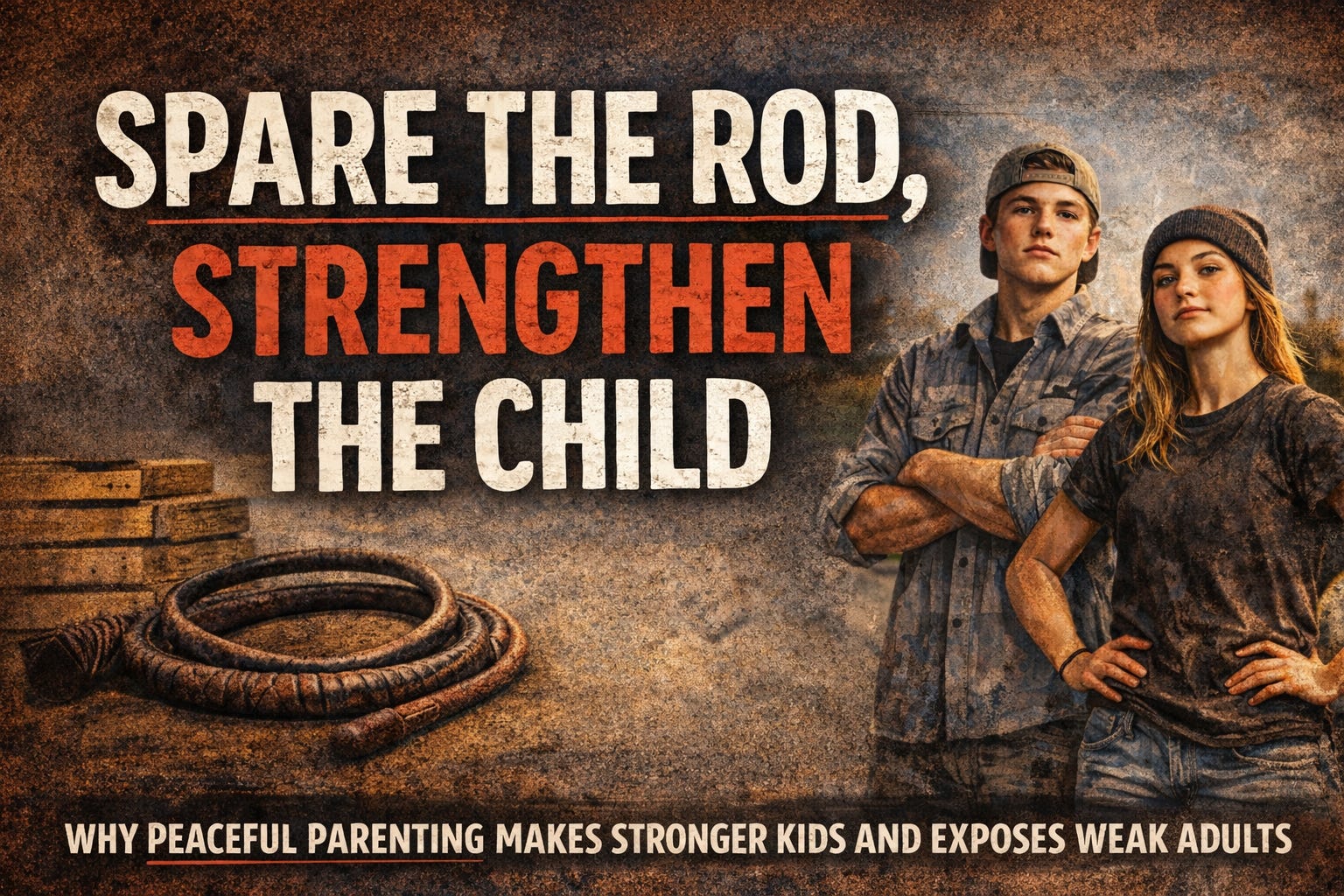
My son, who was raised without yelling, spanking, and punishments, is kicking ass, not weak at all, and confident + capable as a young man, showing more maturity than many adult men who were raised in homes that had corporal punishment.
The fear that you must control your children for them to “turn out alright” is insecurity dressed up as “truth,” and it comes from people who confuse the word ‘control’ with ‘strength’ because that’s the only language they know.
The obsession with “toughening kids up” is perpetuated by adults who justify the way they were raised and their reluctance to do things differently, because that would require effort and work.
Most parents were controlled, shamed, yelled at, intimidated, and hit, so that’s what they believe you’re supposed to do to kids…
It’s not.
These parents didn’t “turn out alright”, they’ve just chosen to avoid facing the anxiety they carry, the rage they manage, and the emotional repression. These parents confuse fear-based obedience with respect and are completely oblivious to the fact that they are the reason our society cowers to a tyrannical government.
“Don’t challenge authority” has greater power over adult behavior and receives more submission than any commandment in the Bible.
Peaceful parenting doesn’t mean absent parenting.
Choosing to remove corporal punishment and yelling doesn’t mean your kid runs the house like a tiny Hitler.
Peaceful parenting means you stop using fear as your main tool.
It means you stop trying to dominate and force-shape your children’s nervous system into a compliant and convenient-to-you machine. It means you set boundaries, enforce standards, and keep your word, without crushing their spirit in the process.
As their parent, you lead, but you don’t terrorize; you correct, but you don’t humiliate in the process of teaching (see: Discipline).
If peaceful parenting made kids weak, then kids raised with freedom and respect would grow into fragile adults who can’t handle responsibility. That’s the narrative and scare tactic used online, but it collapses the moment you see it play out in real life.
My son chose manual labor.
Read that title again…
My son chose to join the landscaping/hardscaping business I work at; he wasn’t forced or coerced into it, he saw what hard work is, he felt the weight of responsibility, and he stepped toward it on his own two feet.
That’s not a weakness, that’s having a backbone; That’s a young man who isn’t running from discomfort because nobody trained him to associate discomfort with shame and punishment.
He can go out and do hard things without needing someone to scream in his face to prove it counts.
As a peaceful parent, I’m now raising children who are self-sufficient, morally grounded, and free of the mania that is running rampant among today’s teens.
Both my son and my daughter are in control of their lives, and I don’t mean that in the immature “I do whatever I want” way (I shouldn’t even have to say it, but this is the internet) I mean that in the real way, in the way that shows up as ownership.
I see this confirmed daily in their self-awareness, decision-making, emotional regulation, and the ability to think under pressure and not fold when the second life gets loud and stressful.
That ability and self-ownership didn’t come from fear; it came from their inner framework, which has been built through years of guidance and permission to fail fostered in the home by my wife and I.
It comes from growing up in an environment where you’re allowed to be yourself and aren’t molded into someone else’s preferences.
Control Creates Compliance/Freedom Creates Capability.
Control might make a kid quiet, but quiet doesn’t mean strong.
Quiet might mean they learned it isn’t safe to speak, or that their words aren’t as valuable as everyone else’s.
Quiet might mean they learned love is conditional.
Quiet might mean they’re scanning for which version of you they’re going to get today and trying to say and do everything right to earn your much-desired validation, approval, and acceptance.
None of those are signs of respect; those are all survival mechanisms, and kids in environments where they’re trying to survive (not thrive) grow into adults who become people-pleasers, liars, join the first gang that will accept them as they are, or become emotional ghosts.
They look “good” as kids because they’re terrified of consequences, then they fall apart later because they never learned how to steer themselves. They only learned how to avoid trouble and to please others.
Peaceful parenting is about developing a child’s internal compass.
This approach to parenting is about teaching them to make good choices because they understand the why, not because they’re afraid of the hammer.
FOLLOW ON TIKTOK FOR VIDEO MESSAGES THAT GO WITH THE WRITTEN ARTICLES HERE
It’s about raising adults, not puppets, and a child who grows up able to say “No” or “Why?” to their parents is one who will grow up with their dignity intact and doesn’t need to “find themselves” at 30 after a decade of chaos…
They already know who they are because nobody spent their childhood trying to break them into submission.
The people who hate peaceful parenting the most are usually the ones addicted to control. They think respect equals fear because fear is efficient. Fear gets fast results. Fear gets immediate behavior change. But fear doesn’t build character—it builds a mask. You might get a kid who “acts right,” but inside they’re learning a different lesson: power wins, vulnerability loses, and honesty is dangerous. Then we act shocked when they hide things, lie, explode, or choose toxic relationships. We trained them for it.
Freedom doesn’t mean absence of standards; it means standards without intimidation.
Is your child “good” because they do the right thing out of fear of what you’ll do to them if they don’t?
Or is a child good because they do the right thing because it is right, and not because they were coerced or avoiding punishment?
You aren’t free if there’s someone in your head scaring you to act a certain way.
In my house, we don’t aim for perfect kids.
Jackie and I are raising capable kids who can handle reality without numbing out, lashing out, or collapsing. Children who become adults who can work hard and stand up for themselves without becoming bullies. We’re raising teens, as we speak, who can take correction without feeling like their worth is on trial.
The fear-mongering is based on ideology, not results.
Corporal Punishment is based on people clinging to the belief that pain equals growth because they don’t know another framework. But pain isn’t the teacher; consequence, accountability, consistency, and the relationship is where the lessons are learned, and a parent who can stay calm, enforce boundaries, and hold their child to a standard without losing their dignity is not weak…
That parent is dangerous in the best way because they’re not ruled by their emotions, their ego, or their own unresolved trauma, and that allows them to teach their children how to grow as individuals without resorting to pain to be used, essentially it’s “Spare the rod, strengthen the child.”
And that’s the whole point of this message, Kids don’t become strong by being controlled.
They become strong by being trusted, guided, corrected, and allowed to build themselves, allowed to fail, and supported when they take chances on themselves without fear, serving as the foundation of their relationship with you or others.
If you want to raise a weak child, make them afraid to be honest, afraid to fail, afraid to feel, and afraid to disagree. Then go and teach them to obey you rather than to govern themselves.
When those “kids” are released to adulthood, don’t act surprised that they’re anxious, lost, or easily influenced by perceived “authority”.
If you want to raise a strong child, lead with respect, teach responsibility without terror, and give them total freedom with suggested boundaries.
Let them feel the weight of their choices while they’re still in the safety of your care, and encourage them to build an identity that isn’t rooted in your approval or avoiding punishment for messing up.
My kids being in control of their lives is what happens when you stop trying to control children and start developing them. It’s what happens when you build strength from the inside out instead of trying to force it from the outside in.
So again, peaceful parenting doesn’t make kids weak; it exposes adults who are soft.
- Zachary Small