

Senior Night games in high school sports have a way of making time feel loud.
The lights hit different, the gym feels smaller, and parents are smiling with that ache behind their eyes…
The Seniors are standing there proud and uneasy at the same time, because they know something is ending, whether they’re ready or not.
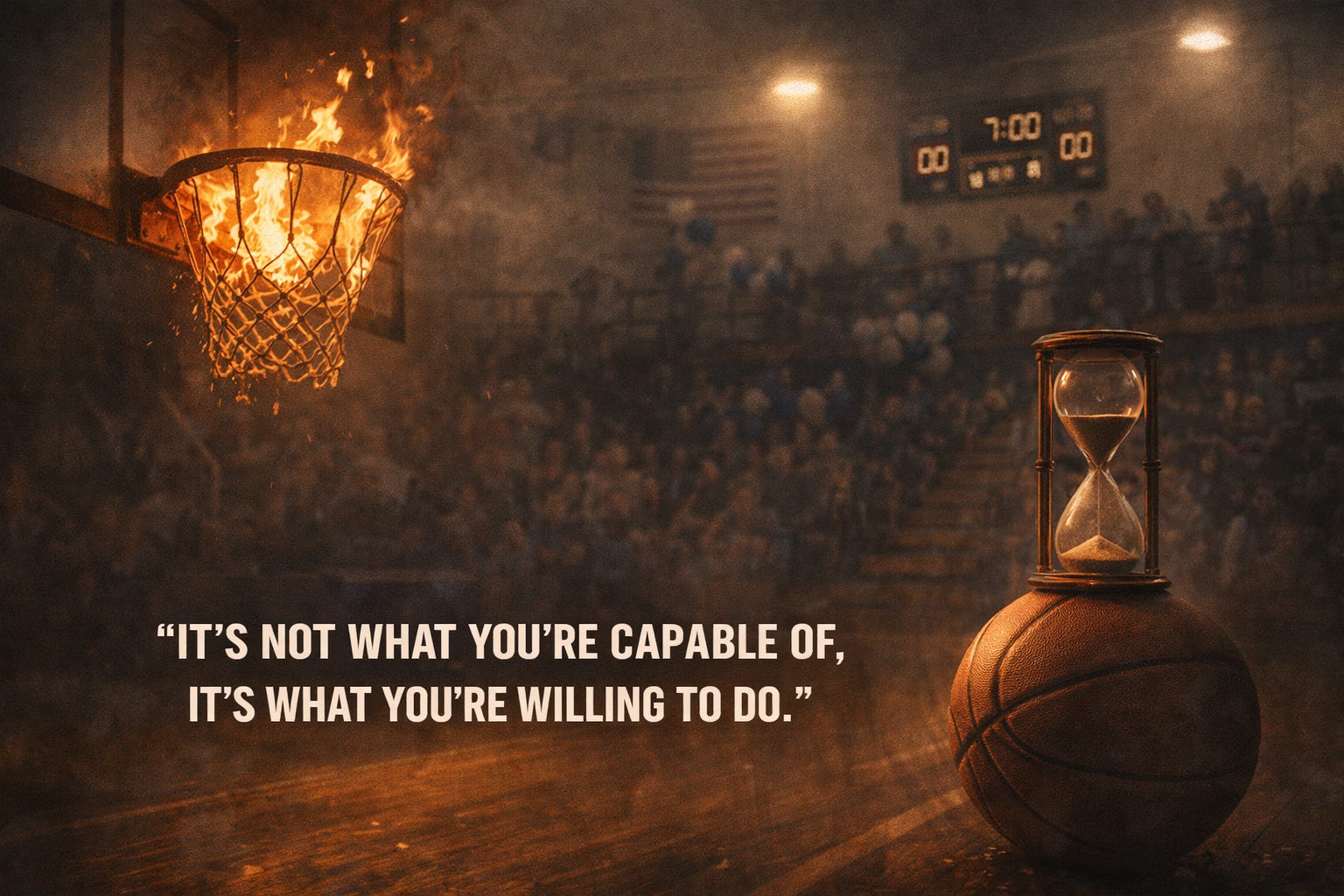
And right in the middle of what could’ve been another clean, sentimental speech, the TEACH Varsity Boys’ Basketball Coach dropped a line that cut through the room:
“It’s not what you’re capable of, it’s what you’re willing to do.”
That isn’t a hype quote, it’s a mirror.
Because capability is comfortable.
Capability is the story we tell ourselves to keep our ego intact. It’s how a man can say, “I could do it if I really wanted to,” and somehow feel accomplished without ever paying the price. Capability lets you live off potential as if it were proof of character.
Willingness is different.
Willingness is where the excuses die.
Most people aren’t stuck because they can’t; they’re stuck because they won’t. They won’t wake up earlier, they won’t stop feeding the habits that keep them foggy, won’t make the call to have the uncomfortable conversation, won’t do the boring reps long enough to become dangerous…
They won’t stay consistent when nobody’s watching.
And if this resonates, I’m not saying that to shame you; I’m saying it because it’s true, and a lot of good people are carrying guilt they don’t need to carry. The TEACH Coach wasn’t just talking to the seniors when he dropped that banger; he said it to everyone in that gym who thinks their problem is a lack of potential, and it’s not.
The problem is they’ve been negotiating with their life.
Potential isn’t power; it’s unused fuel.
You can be capable of a lot and still live timidly; not because you’re weak, but because comfort is addictive, “later” is a drug.
The safety of avoiding embarrassment is addictive, and the longer you live in that safety, the more “normal” it starts to feel.
That’s why the quote hits so hard on Senior Night.
Those seniors aren’t being judged on what they could do someday; they’re being honored for what they were willing to do when it mattered…
Practicing when they were tired, how they responded to getting benched, how they handled pressure, how they treated their teammates, and how they stayed disciplined when the season got hard.
Capability is the engine, and willingness is the ignition; many men have a strong engine, but never turn the key.
Most people know what to do.
They’ve listened to the podcasts, read the books, saved the videos, and written notes of all the plans and “one day” goals they want to achieve.
Mentally, most people are undefeated, but here’s the thing about “knowing” what to do…
Your body doesn’t care what they know.
Your marriage doesn’t care what you know.
Your bank account doesn’t care what you know.
Your kids don’t care what you know.
Life only responds to what you’re willing to do consistently.
Consistency is where most people break, not because they’re lazy, but because consistency requires an identity shift. It requires pain tolerance, doing the thing when your emotions are begging for relief, and that is the moment when most people start bargaining with their commitment:
“I’ll start Monday.”
“I’ll lock in after this season.”
“I’ll do it when work slows down.”
“I’ll get serious when I feel better.”
“I’ll go hard when I have more energy.”
I get it, that voice sounds reasonable, and it even sounds responsible, but life doesn’t reward intentions; it rewards decisions, the ones that you keep.
That coach wasn’t just talking to boys.
He was talking to the part of a man that still wants to rise; the part that knows, quietly but clearly, “If I were truly willing, my life wouldn’t look like this.”
Because willingness is a mirror you can’t lie to.
If you say you want to be in shape, but you’re not willing to train when you’re tired, you don’t actually want the result; you want the idea of it.
If you say you want peace, but you’re not willing to cut the habit that keeps dragging you back into chaos, you don’t want peace; you want comfort with occasional relief.
If you say you want a stronger marriage, but you’re not willing to lead, apologize, initiate, pursue, communicate, and take responsibility for the emotional climate in your home, then you don’t want a stronger marriage; you want it to get easier without you getting better.
If you say you want to be a better father, but you’re not willing to change your patience, your presence, your discipline, your health, and your habits, then you don’t want “better,” you want your kids to remember you as better than you were.
That quote exposes the gap between what we claim and what we commit to, and that’s not condemnation, it’s clarity.
So let’s make it simple and practical: If you want your life to change, stop asking, “What am I capable of?” and start asking, “What am I willing to do?”
What are you avoiding right now?
The answer is usually the doorway, the workout you keep skipping, the phone call you keep delaying, the conversation you keep rehearsing but never have, the habit you keep defending, the truth you keep burying…
Avoidance is expensive; it charges interest.
What are you unwilling to sacrifice?
Most people want the result without paying the price.
They want confidence without effort, respect without discipline, money without risk, and a great marriage without humility.
What are you willing to do daily, even when it sucks?
Not the perfect plan.
Not the exciting plan.
Willingness isn’t heroic; it’s repetitive.
The plan you can do on your worst day.
And what story are you telling to protect your ego?
“I’m busy.” “I’m stressed.” “I’ve been through a lot.” “I’m not motivated right now.” Some of that might be true, but true doesn’t always mean useful; Pain is real, but it’s not permission to stay stuck.
Here’s the part that’s both freeing and challenging…
You already know what you need to do.
You don’t need more information; you need more willingness.
Willingness to be honest, to stop pretending you’re fine, to stop waiting for rescue, and to accept that nobody is coming to save you.
Senior Night is symbolic because it’s a checkpoint, one that says, “This chapter is closing. What did you do with it?”
And one day you’ll have your own Senior Night moment, not in a gym, but in a quiet room when you realize time moved whether you were ready or not.
When your kids are older, your body is older, your chances have narrowed, and the excuses stop working.
In that moment, capability won’t comfort you; willingness will.
So here’s the challenge for all of us, a simple, honest call-to-action:
Pick one thing you’ve been “capable” of for years but not willing to do, and do it today; not perfectly, and maybe not forever, but do the thing you said you could do, today. A perfect example in my life, photography…
I always said I’d be good at it, from my teens until 30, then I went and did it, proving I was right. It’s your turn to prove you’re right, or accept you overestimated your willingness and/or capability.
Either way, at least you’ll know, and that in itself is progress.
That coach gave those seniors a gif; not a hype speech, but a compass in life.
“It’s not what you’re capable of; It’s what you’re willing to do.”
Now you get to decide if it’s just a quote you liked, or a line that changes how you live.
- Zachary Small