

Say it out loud.
Go ahead.
Because if you’re holding this book, there is a solid chance that that sentence (“I can stop whenever I want”) has lived in your head for years, and every time someone got close to the truth about your drinking, that was the line you reached for…
I can stop whenever I want.
It is the most common lie in the history of addiction, and the reason it works so well is that it sounds reasonable, as it sounds like control, and like the kind of thing a person with a problem would never say, which is exactly why people with problems say it all the time.
I said it for years…
I said it after the blackouts.
I said it after the fights.
I said it after waking up on the floor or in my own bed with no memory of how I got there. I said it in the Navy when drinking was just what we did; we were young men, at war, and we needed to vent some of the pressure that comes with living that life, in that environment…
I said it when I was thirteen years old, sneaking bottles out of my family’s cabinet, and I said it at thirty-three when I realized I’d somehow created a life where I actually did have something to lose.…
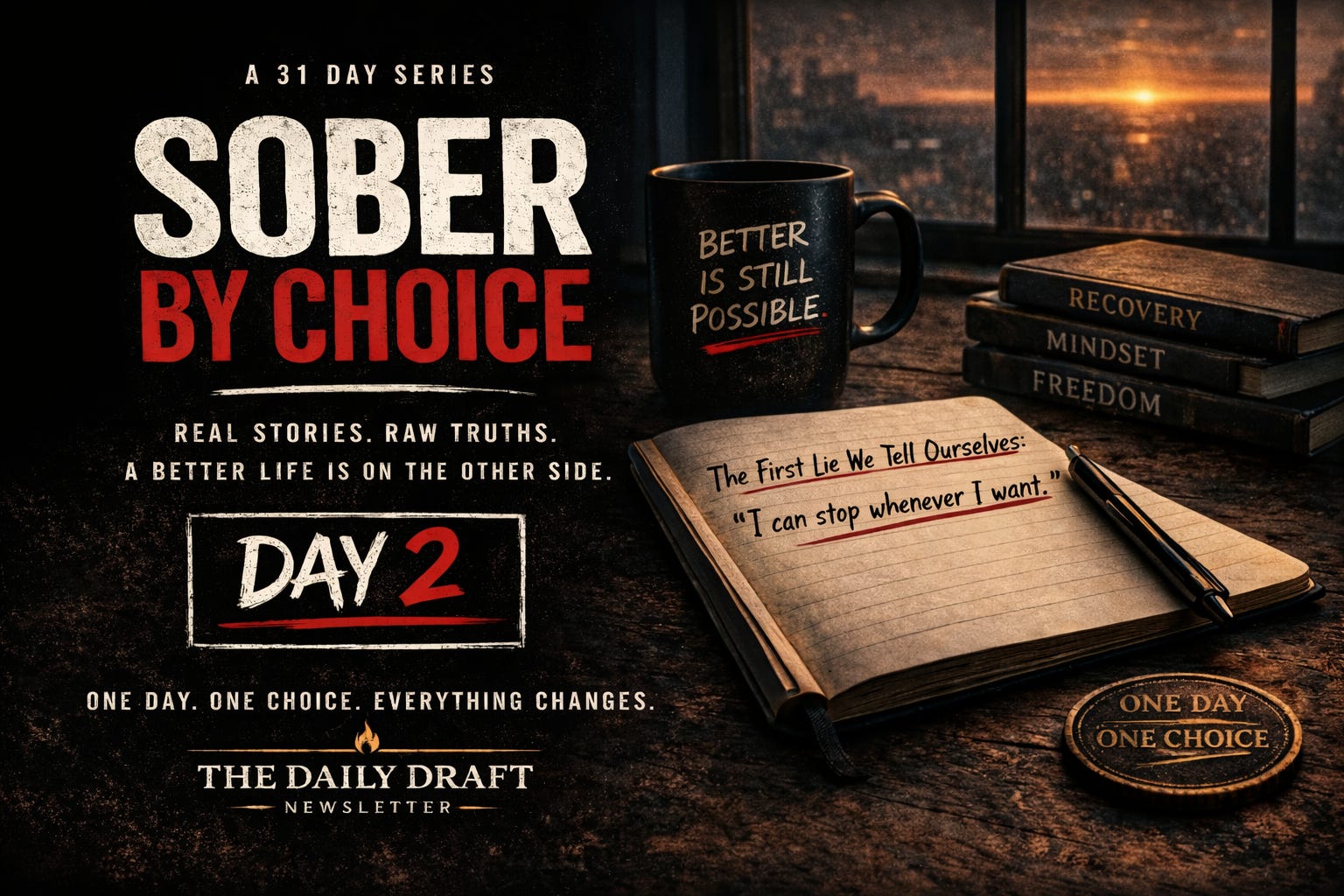
I can stop whenever I want.
Here is the thing about that lie, it is not just something you say to other people. It is something you say to yourself, over and over, until you believe it the way you believe the sun comes up in the morning. It becomes part of your operating system, and once it’s in there, it starts running in the background of every decision you make.
You don’t ask for help because you “don’t need it,” you can stop whenever you want. You don’t tell your love the truth because you can stop whenever you want. You don’t read sober content, or accept the invitation to the sober meeting, or answer the honest question from the friend who’s watching you disappear, because you can stop whenever you want.
(This part might sting a little)
The lie doesn’t just protect the drinking, it protects you from having to face what the drinking is protecting you from.
And that is where it gets interesting.
Because underneath “I can stop whenever I want“ is another lie, a quieter one, one you probably haven’t said out loud yet, and that lie sounds like this, “If I stop, I won’t know how to function, because the alcohol masks the pain.“
That is the real one; that truth right there is the truth and thought that’s worth pulling apart.
Alcohol became your social lubricant because you were insecure and didn’t want to be seen or heard. It became the thing that made the room easier to walk into, the silence less unbearable, and the version of yourself that showed up to the party feel like someone people actually wanted around. It became the off switch for the part of your brain that wouldn’t shut up about everything you hadn’t dealt with. It wasn’t just a drink, it was a system that solved problems; alcohol let you stop worrying and remembering, but nobody told you that the more you used it, the more it took from you, and you never worried about losing yourself, and you stopped remembering how to be happy without it it; you entered a world where you only felt good when you felt nothing at all, except the crisp drink, that made the noise go flat, and you returned to the sweet relief from life, “here,” but not.
This is not me telling you that you are weak or broken, this is me telling you that you turned alcohol into a coping habit, and it worked, but now you are being asked to tear it down before you know what you will build in its place, and tha tmeans you won’t know how to cope, at least not at first, and that is terrifying; I know it because I lived it.
But here is what I need you to understand before Day 3.
The lie you told yourself, “I can stop whenever I want,” is not the enemy; the lie is a symptom. It exists because something underneath it was a you that needed protecting. Your job over the next 30 days is not to beat yourself up for believing it; your job is to get honest enough to find out what it was protecting you from.
You cannot fix what you refuse to see, and you cannot see that which you refuse to admit exists.
So today, we take the lie off the table…
Admitting to an underlying issue does not fix it, and admitting to a problem does not need to be accompanied by shame. I’m asking that just for today, just long enough to ask the question the lie was built to prevent, that you give yourself permission to accept that maybe you can’t stop because you haven’t yet accepted, this harmless habit has become a part of your identity, and a method to handle the things you don’t want to face in life. That acceptance opens you up to answering this question…
What are you actually afraid would happen if you stopped?
Your Day 2 Sober-Challenge
Finish this sentence, and be brutal about it:
“I kept telling myself I could stop whenever I wanted because if I admitted I couldn’t, I would have to face...“
Write whatever comes after that; don’t clean it up or try to make it sound good…
The only person who has to read it is you.
That sentence is the first crack in the wall.
- Zac