

DEAR DADS Part I was about stopping the internal beatdown, because a man who hates himself can’t lead with steadiness.
Part II is what comes next, because many fathers will repeat the same cycle in different ways as they try to change.
These men stop talking shit to themselves, then keep living like a man who doesn’t trust his own word while lashing out at others due to their personal frustrations.
Different Packaging, Same Poison
If you’re still emotionally unpredictable, still snapping, still shutting down, still disappearing into your phone, still making your home feel like everyone has to manage your mood, then your self-respect is still theoretical.

Your family doesn’t live inside your intentions; they live inside your patterns.
If you’re looking to get things back on track but your patterns are chaotic, your kids will grow up thinking love feels like walking on eggshells.
Your decision to improve your life cannot be followed by self-resentful behaviors, even as you recognize how far you have fallen…
Yes, stepping out of the destruction is a good choice, but it leaves you in a position to finally look at yourself from the outside, and here is where you see just how far you have fallen from where you were, and just how much damage you have done to those you say you love most…
That can be extraordinarily painful; don’t let it be an anchor that pulls you further from your best; let it be fuel.
From my experience working with men in the roles of mentor, life coach, consultant, and friend, most fathers struggling aren’t “bad dads” at all; they’re just unprocessed men who are stuck.
They’re carrying old anger, old shame, old fear, old resentment, and instead of naming it and dealing with it, they repress it. But, as everyone should know, “the body keeps the score” and that repressed self is going to force its way out in ways you cannot control, and may not be aware…
That repressed self is found in the unintentional angry tone of voice, it’s found in one’s short patience, it comes out when a man is “listening” but not present.
Your repressed self makes your family feel like an interruption to your life instead of a beautiful part of it; that’s not leadership, that’s emotional littering.
Your family shouldn’t have to guess which version of you is coming home: the one who is motivated to get better, or the one who hates himself for wasting so much time…
A father’s job isn’t to be perfect; it’s to be predictable in the ways that matter, like being safe, steady, and reliable, not bipolar.
Let’s kill the biggest excuse dads hide behind, which is that they’re at least being “a good provider”; because a roof overhead, clothes on their back, and food on the table doesn’t excuse you from being an emotionally unsafe presence in the home.
Working a job that pays you doesn’t give you a hall pass to be volatile, distant, numb, or constantly irritated.
Your wife didn’t marry a paycheck, and your kids didn’t ask for a financially responsible stranger who lives in their living room. If you’re providing, but your presence makes the room tighter, you’re not protecting your family; you’re funding a life where they don’t feel fully connected to you.
The most powerful thing a father can do is own his nervous system and be fully integrated into who he is as a man.
I’m not saying be calm because you gave up or calm because you’re restraining yourself…
I’m saying be calm because you refuse to let your emotions bully your family. A non-negotiable in your home should be that no one in your house should fear your mood; Not your wife, your kids, or even the dog.
If your mood is the boss of your home, you’re not leading with healthy responses; you’re reacting with weakness and emotional dysregulation.

 Tiktok failed to load.
Enable 3rd party cookies or use another browser
Do Something Practical Instead of Dramatic
Before you walk through the door, take ninety seconds and decide who you’re about to be.
Breathe slower than you want to, drop your shoulders, unclench your jaw, and make the right call.
Because whatever happened out there in traffic, at work, with money, or any drama, it doesn’t get to take hostages in here. Your home is not the dumping ground for the parts of your life you refuse to process.
And that frustration you feel now that you’re out of the tornado you were in, channel it into being the reminder of why you’re looking to get better. Don’t let self-improvement be the final straw to your marriage or family relationships; it’s meant to heal, not hurt.
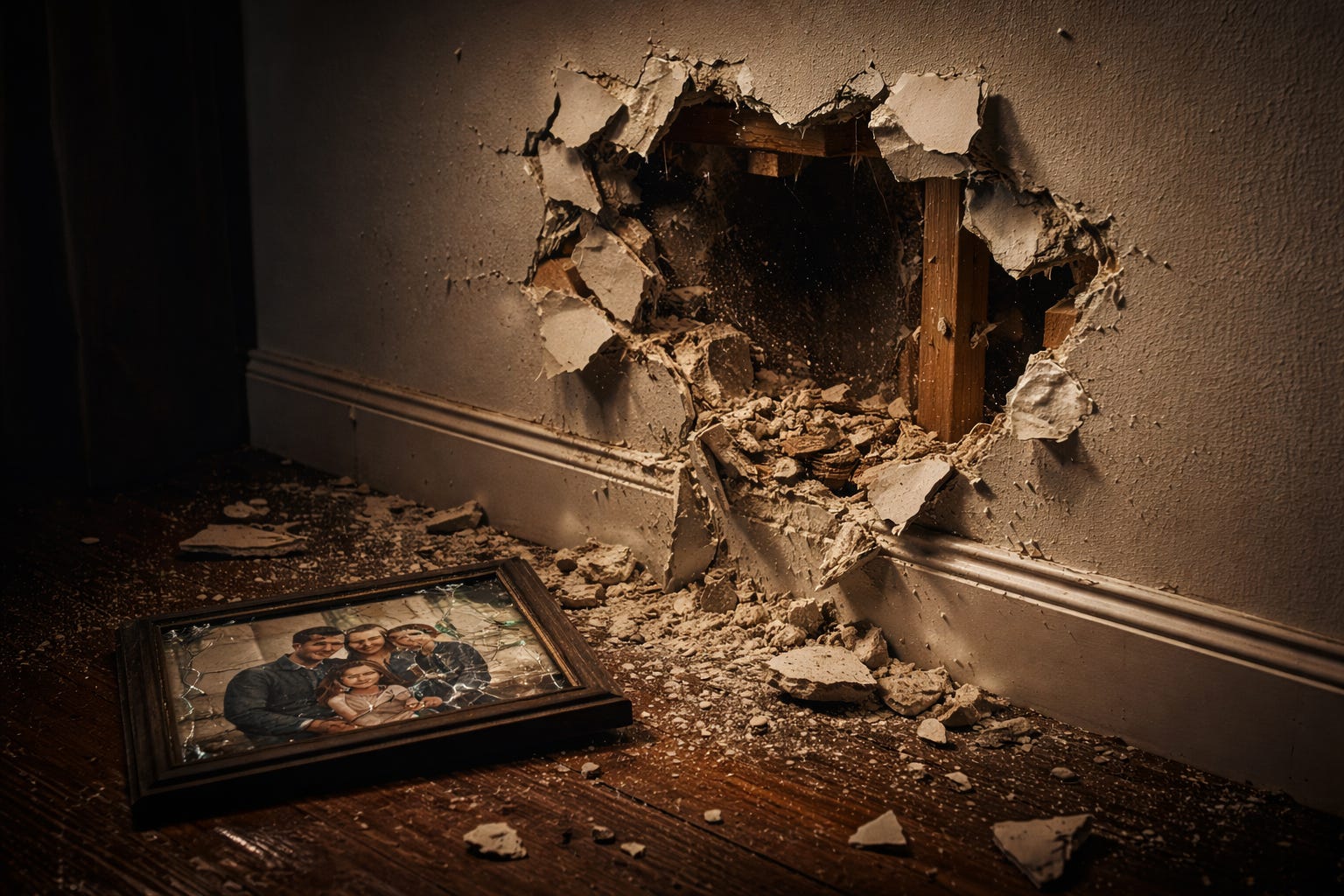
Confidence doesn’t come from hype; it comes from receipts.
Your word is either the law or a joke you keep telling yourself. Stop making promises that depend on motivation, and stop saying “I’m going to start” as if you’re waiting for permission from your feelings. Pick a few standards to hold and actions that you live by, even when you’re tired, even when you’re pissed off, even when the day goes sideways, because consistency is what makes a family feel safe.
When you screw up, you repair it fast instead of brooding for three days and acting like silence is maturity.
When your kid wants your attention, you look them in the eyes instead of at a screen.
When conflict arises, you handle it like a professional instead of avoiding it until it festers.
When you’re overwhelmed, you communicate rather than explode.
When you’re taking actions to be better (Working out, budgeting, being calm, putting the phone away), don’t stew over how you got fat, poor, or distracted…
Do the above and become a father who can be relied on by his family.
And if your ego won’t let you apologize to those you hurt, understand that you’re fragile.
The apology for what you did or who you were isn’t weakness; it’s dominance over your ego.
If you snapped, you don’t “move on” as if nothing happened, you don’t bury it under a fake smile, you own it. You say, “I was out of line. You didn’t deserve that. I’m working on it. I love you.” That’s not soft, that’s stable; it’s a father building trust on purpose instead of expecting everyone else to just “understand.”
You don’t get to arrive (product), you get to build (Process).
This is about becoming the kind of father whose presence calms the room instead of tensing it. The kind of husband whose wife doesn’t feel like she has to emotionally manage him. The kind of man whose kids grow up thinking, “Dad was solid. Dad was safe. Dad was there...”
So if you needed a sign to stop bleeding old pain onto the people you love the most, this article was it.
Stop letting stress turn you into a stranger, and stop acting like your emotions are uncontrollable when you’ve never trained them.
Get serious, not with self-hate, but with standards, and you’re capable of that, so start acting like it.
- Zac Small